Embedded Flying Cutoff is application-specific software that controls a flying cutoff die accelerator drive system — embedded within the drive controller to eliminate external control racks.
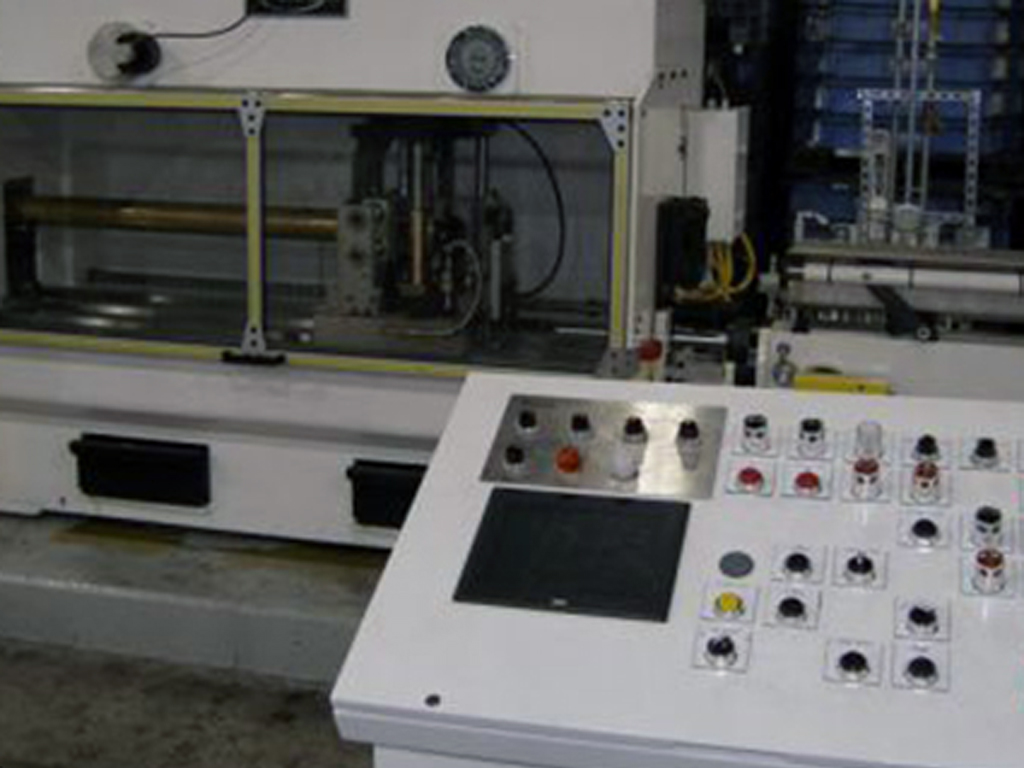
Embedded Flying Cutoff is application-specific software that controls a flying cutoff die accelerator drive system. The program is embedded within the controller of a drive, eliminating the need for an external control rack.
When used in conjunction with a programmable controller, the drive forms a powerful automation work cell that can either stand-alone or be easily integrated with other automation cells to build a complete control system. Embedded control reduces system complexity while taking full advantage of the exceptional performance, flexibility, and ease of use of the drive.
Purpose-built control features engineered for precision, flexibility, and throughput on every flying cutoff application.
The flying cutoff control cuts a continuously moving strip of material into lengths by accelerating a die to synchronize with the material, make its cut, and return home to await the next cycle. A measuring wheel is used to track the movement of the material. Two different modes offer the choice of cutting prescribed lengths or cutting relative to printed registration marks or holes using a mark detector to scan the material. Windowing features minimize spurious mark errors.
To maximize production, the software calculates an ideal home position to which the die returns between cuts. This is the furthest point the die must go to accommodate a given length at maximum line speed. This approach dramatically improves the accuracy of cuts made while the line is accelerating and increases production when cutting short lengths. Alternately, a traditional fixed or dynamically calculated home position may be used.
Two different part lengths and batch sizes can be specified at once, allowing the operator to set up the next order while the current one is running. A single length may also be produced indefinitely. Orders change automatically at the end of a batch or when requested by the operator. A customizable early warning feature indicates when a batch is nearly complete. If a defective piece is removed, a reject part input lets the operator correct the part count.
Selectable cropping methods provide a choice between cutting a fixed-length piece, cutting the shortest possible length for the given line speed, and cutting a length specified by how long the operator holds down the crop button.
Several simulation tools facilitate setting up, testing, and troubleshooting a flying cutoff system. A line simulator makes it possible to run the cutoff without material by simulating the feedback that the measuring wheel would provide as the line ramps up, ramps down, or runs at speed. A mark detector simulator produces marks at a specified separation to allow testing in cut-to-mark mode. A shear simulator is useful for testing carriage travel without firing the ram.
Alternate tuning can be used during the duration of a cut to accommodate flying saws and other machines having lengthy cut engage times.
An operator interface provision provides dedicated support for P-Terminal, an optional four-line by 40-column liquid crystal display, and a keypad that mounts on a panel. Simple, function-key-driven screens let the operator enter batches, view line status and production information, modify cut-to-mark settings, calibrate the measuring wheel trim, as well as access setup parameters. Other operator devices can easily be connected using one of the serial communication options.
The program detects and protects against a number of fault conditions specific to a flying cutoff application, including out-of-tolerance parts, forward rack overtravel, and line-too-fast situations where the line is unable to produce the given length at its current speed. The software can also detect missing or erroneous marks and recover by making the cut at the expected location.
A variety of serial communication protocols are supported for interfacing with a programmable controller or operator interface. The DF1 and ANSI protocols are standard. The drive can also communicate via Remote I/O, Modbus Plus, ControlNet, and Profibus using the appropriate communication module.
A variety of input/output functions are provided for integrating the flying cutoff control with external devices. The user can select the functions required by a given system and specify their corresponding hardware or serial I/O points.
Standard I/O functions available for integrating the Flying Cutoff control with external devices.
| Input | Output |
|---|---|
| motor on | motor on |
| fault reset | outputs 0–31 |
| manual | serial outputs 0–15 |
| auto | motor on |
| auto | motor on |
| auto run | no fault |
| jog forward | manual |
| jog forward | auto |
| reference-request | crop |
| auto | forward limit |
| crop request | reverse limit |
| cut engaged | fire shear |
| reference switch | reference grant |
| advance mark | line too fast |
| batch reset | forward limit fault |
| part reject | part error |
| clear mark queue | detector error |
| fast stop | batch complete |
| motion enable | early warning |
| in motion | |
| forward motion | |
| reverse motion |
Talk to our engineers about the Flying Cutoff module for your application.
We are proud to partner with some of the most respected names in manufacturing and industrial processing.