The FTR™ drive is engineered specifically for controlling feed-to-register applications that use a sensor to detect a preprinted mark or mark pattern.
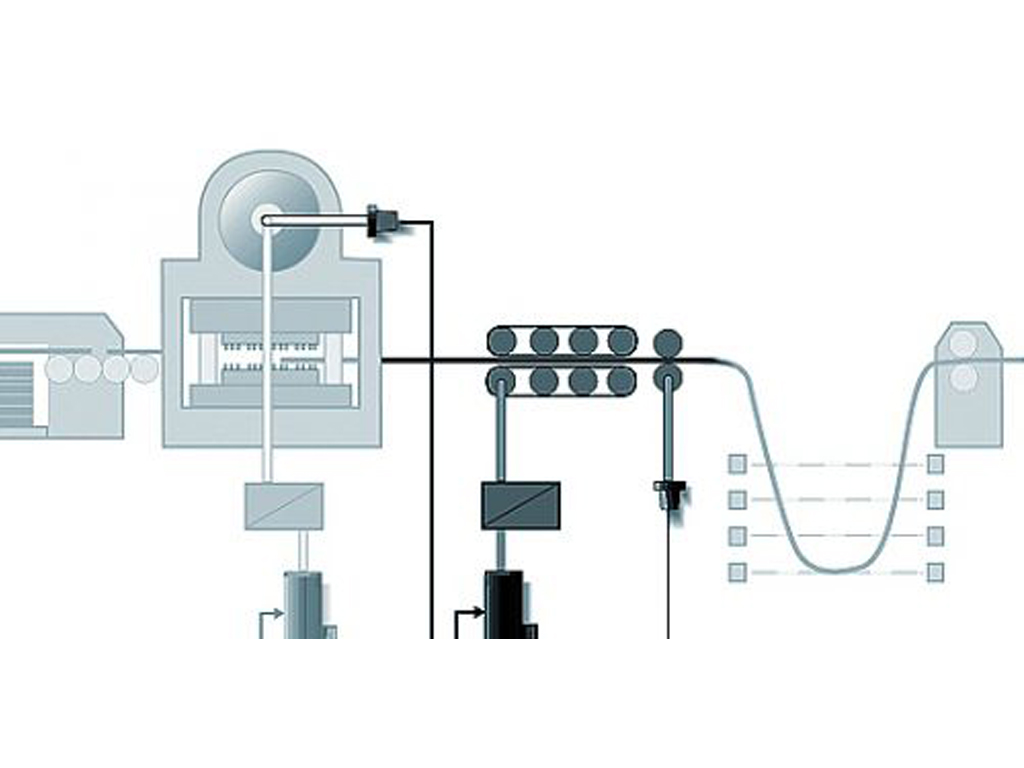
The FTR™ drive is engineered specifically for controlling feed-to-register applications that use a sensor to detect a preprinted mark or mark pattern and index the web with a settable feed length.
Control software embedded within the drive eliminates the need for an external control rack. When used in conjunction with a programmable controller, the drive forms a powerful automation work cell that can either stand-alone or be easily integrated with other automation cells to build a complete control system for a web-processing line.
Embedded control reduces system complexity while taking full advantage of the exceptional performance, flexibility, and ease of use of drives.
Purpose-built control features engineered for precision, flexibility, and throughput on every feed-to-register application.
In this mode, the feeder follows an internally simulated profile using the feed initiate and cut engage inputs to control the feed cycle. The feeder starts the feed when the feed initiate input is set. When the feed is complete, the feed complete output is set.
The press can then be cycled to clear feed initiate and set the cut to engage a bit. When cut engage is set, the feed complete output is cleared. As the shear continues to cycle, the feed initiate input is again set to start another feed.
In synchronous profile mode, the feeder is electronically line-shafted to the press. It follows an external reference signal, typically an encoder or resolver mounted on the press. By taking advantage of the full feed angle, this mode results in higher production rates while minimizing slippage.
The feeder responds quickly to changes in line speed, allowing the line to accelerate rapidly without the risk of jamming. The feeder never operates faster than is necessary, thereby minimizing violence in the loop between the feeder and web delivery section.
Trapezoidal feeding with S-curve smoothes the command by rounding the sharp corners of the velocity profile. While most feeders operate in a profiling mode, the trapezoidal mode can be used if a press-mounted encoder is not available.
Jog feed is a manual function useful during set-up that jogs the feeder forward or reverses one part length. When the length is reached, the drive stops and remains in position. The drive can also be jogged any distance forward or reverse.
The single feed function feeds one length at a pre-programmed speed. The single feed input must be toggled for subsequent single feeds.
The micro-adjust feature minutely adjusts the feed length by adding or subtracting a programmable offset to the current feed-to-register length.
Lengths may be quickly changed on the fly by entering a new length into the next length location, then setting an input to make the changeover.
The operator can specify the number of parts to be counted in applications where multiple pieces are cut or stamped with each feed.
The operator can set up batches consisting of a number of feeds of a given length that the drive will feed before stopping.
An early warning output is set when the batch is nearly completed. The output can be used to alert the operator or to slow the line down and make other preparations.
The drive calculates the maximum line velocity and outputs it as an analog reference signal for controlling the speed of the web delivery section. If a drive is also used on the web delivery section, the reference velocity is communicated via a fiber-optic serial link for optimal synchronization.
The drive supports a variety of serial communication protocols for connecting to virtually any PLC or HMI. The drive can also operate in a stand-alone mode using the built-in keypad/display with an ANSI protocol connection to a simple serial display unit.
Protocols supported: CANopen, CC-Link, ControlNet, DeviceNet, Ethernet, Interbus, Modbus Plus, Modbus RTU, Profibus, Remote I/O (2000 family only), RS-232/422/485.
All inputs and outputs are user-enabled and are mapped to hardware I/O points to allow customization of the control. They are also accessible through a high-speed serial communication link.
| Input | Output |
|---|---|
| motor on | motor on |
| fast stop | no fault |
| automatic | reject gate close |
| continuous cut | reject gate open |
| single cut | shear cutting |
| jog forward | shear ready |
| jog reverse | |
| reference/home/auto | |
| scrap track | |
| scrap bin full | |
| motor air flow OK | |
| motor thermal OK |
Talk to our engineers about the FTR™ module for your paper converting application.
We are proud to partner with some of the most respected names in paper converting and industrial processing.